Without structured knowledge
AI rediscovers, every time
- Question
- AI Agent
- Find source
- Read source
- Infer relationships
- Find more source
- Infer dependencies
- Reason
- Answer
- Repeated discovery
- Large context
- Higher cost
- Incomplete knowledge
Give AI agents trusted knowledge of your IBM i applications.
Large enterprise applications are too vast and interconnected for AI to reliably rediscover their structure from source code every time you ask a question.
MDiQ uses native IBM i parsing to build and continuously maintain a deep Application Knowledge Graph — mapping code, objects, data and their relationships.
Through MCP, REST APIs and SQL Stored Procedures, MDiQ provides AI agents, developers and development tools with precise, structured application knowledge — without requiring AI to repeatedly analyse millions of lines of source.
AI that understands your IBM i applications. Governance that keeps you in control.
Get to the answer, faster
No repeated analysis of millions of lines of source
Known relationships, not AI inference
Accurate, connected, actionable
Why MDiQ?
Without structured application knowledge, an AI agent may need to rediscover how your application fits together from source code every time you ask a question.
Without structured knowledge
With MDiQ
MDiQ supplies the structure already parsed, mapped and connected — and automatically kept current through CI/CD triggers.
AI integration
Use the AI agent you choose.
MDiQ provides AI agents with structured, deterministic knowledge of IBM i applications through Model Context Protocol (MCP).
Instead of requiring an agent to discover application structure from source code, MDiQ can provide the relevant programs, procedures, files, fields, variables, parameters, dependencies and relationships as targeted structured knowledge.
Designed to integrate with MCP-capable AI agents and development environments, including IBM Bob and other compatible tools.
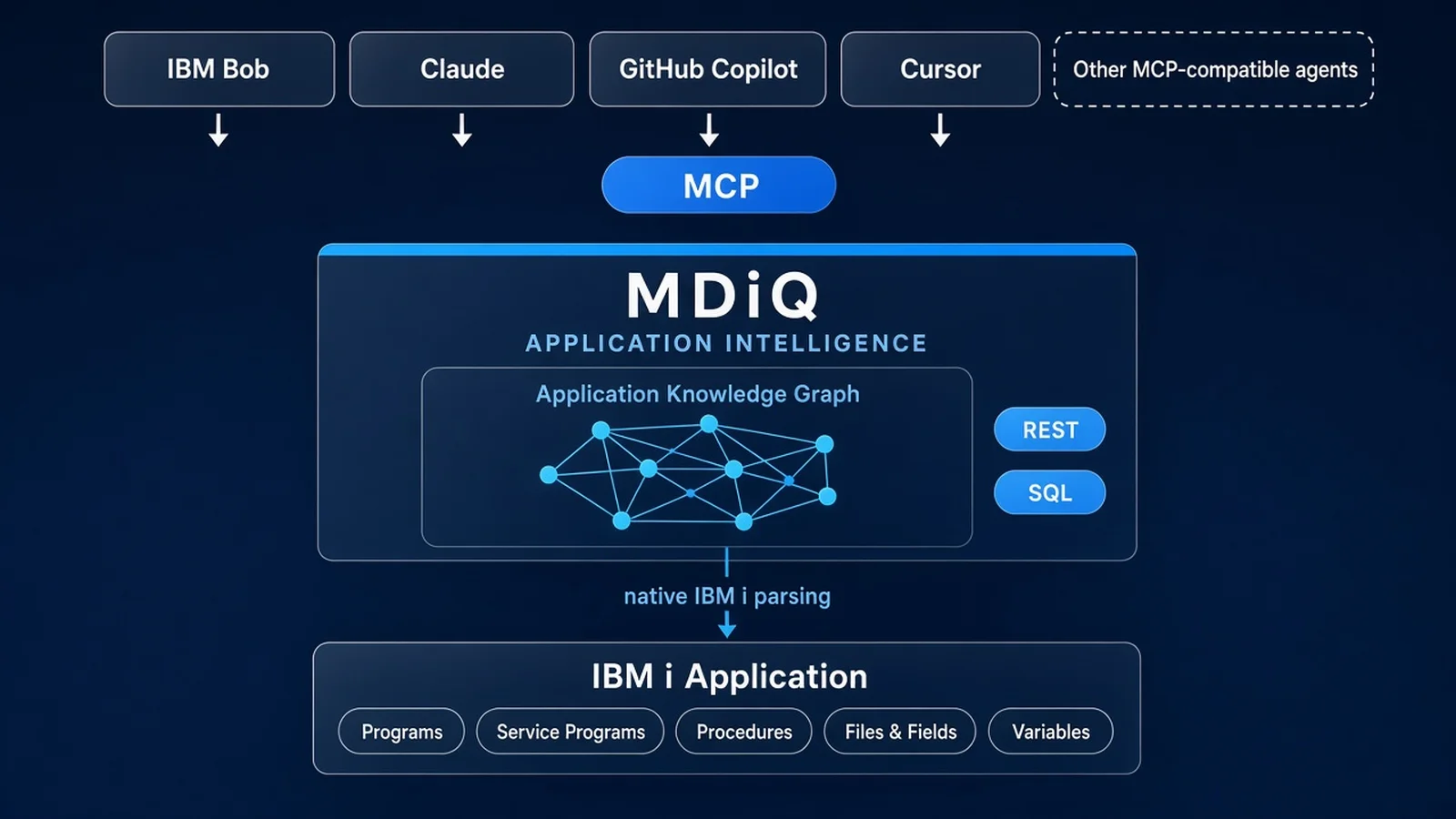
MDiQ provides the application intelligence layer independently of the AI agent consuming it. MCP is a major integration mechanism, but REST APIs and SQL Stored Procedures remain available — so MDiQ is never tied to a single AI vendor or model.
Even when AI is deployed locally, MDiQ reduces the need to repeatedly load, search and interpret large source repositories.
The technology that powers MDiQ
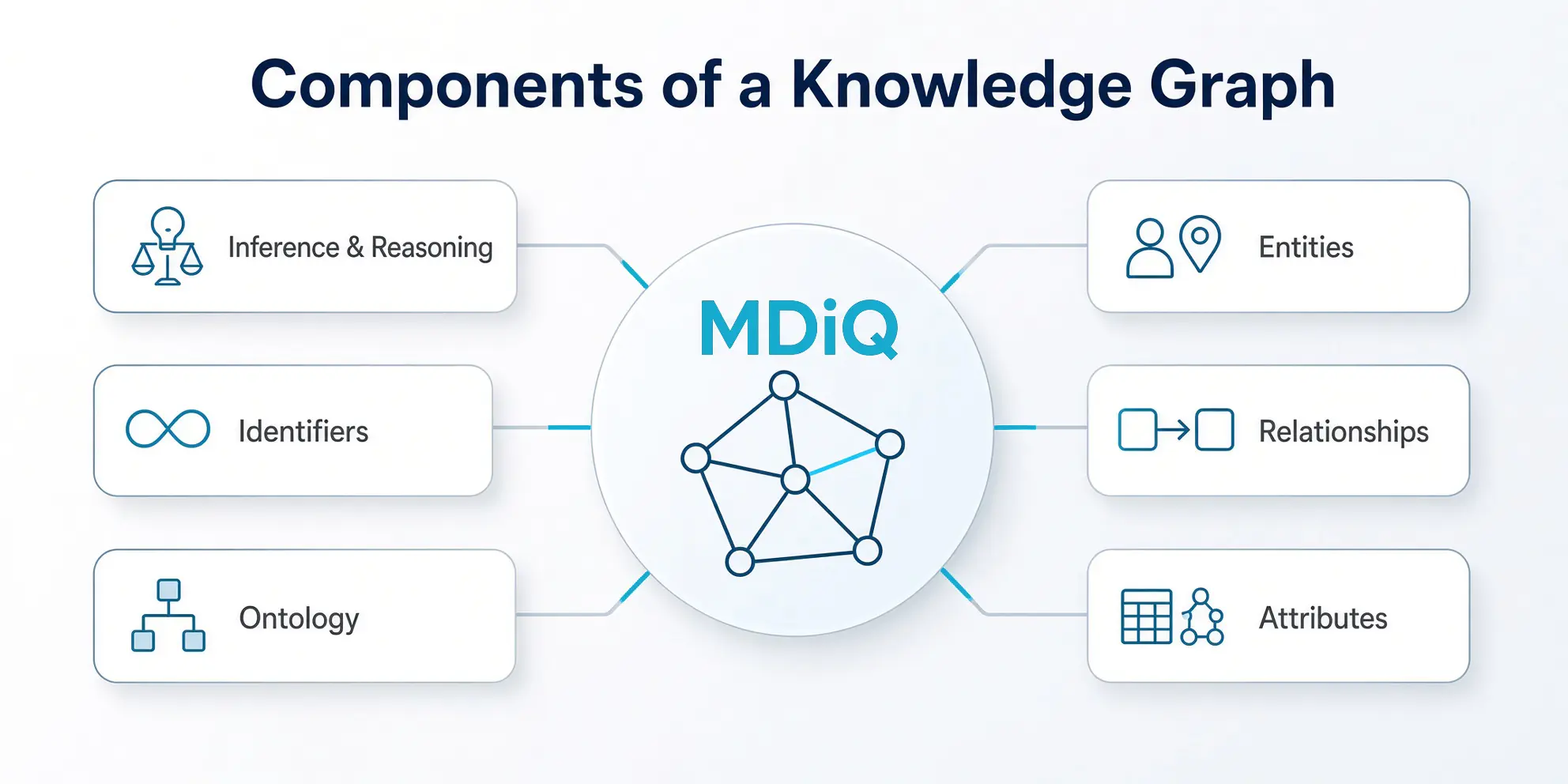
MDiQ builds the cross-reference you always wished you had: a comprehensive node-labelled, directed relationship map of your IBM i application that captures not just source code, but the complete application structure and the relationships between its assets. It is not a list of objects or a source-code search index.
Programs, service programs, modules, procedures, database tables, files, fields, variables, parameters, subroutines, displays and other application entities are represented as interconnected nodes — creating a precise structural map of what exists, how it is related and how the application works as a whole.
This gives developers — and AI agents — a reliable way to navigate the application from any starting point, follow dependencies and understand impact across the system.
Instead of asking AI to guess how a legacy application works from isolated pieces of source code, MDiQ gives it the map of the application first.
Built on IBM i expertise
Understanding which IBM i objects depend on each other is only the beginning.
MDiQ’s native parsers analyse application source and object metadata to understand relationships inside those objects — and the knowledge graph is automatically kept current through CI/CD triggers.
The parsers were developed by experienced IBM i experts — including contributors to IBM Redbooks and authors of commercial legacy analysis products.
Accurate and comprehensive
MDiQ uses IBM i-native parsing to extract and understand your application’s real structure — not just text, but meaning.
What MDiQ captures
Real application context
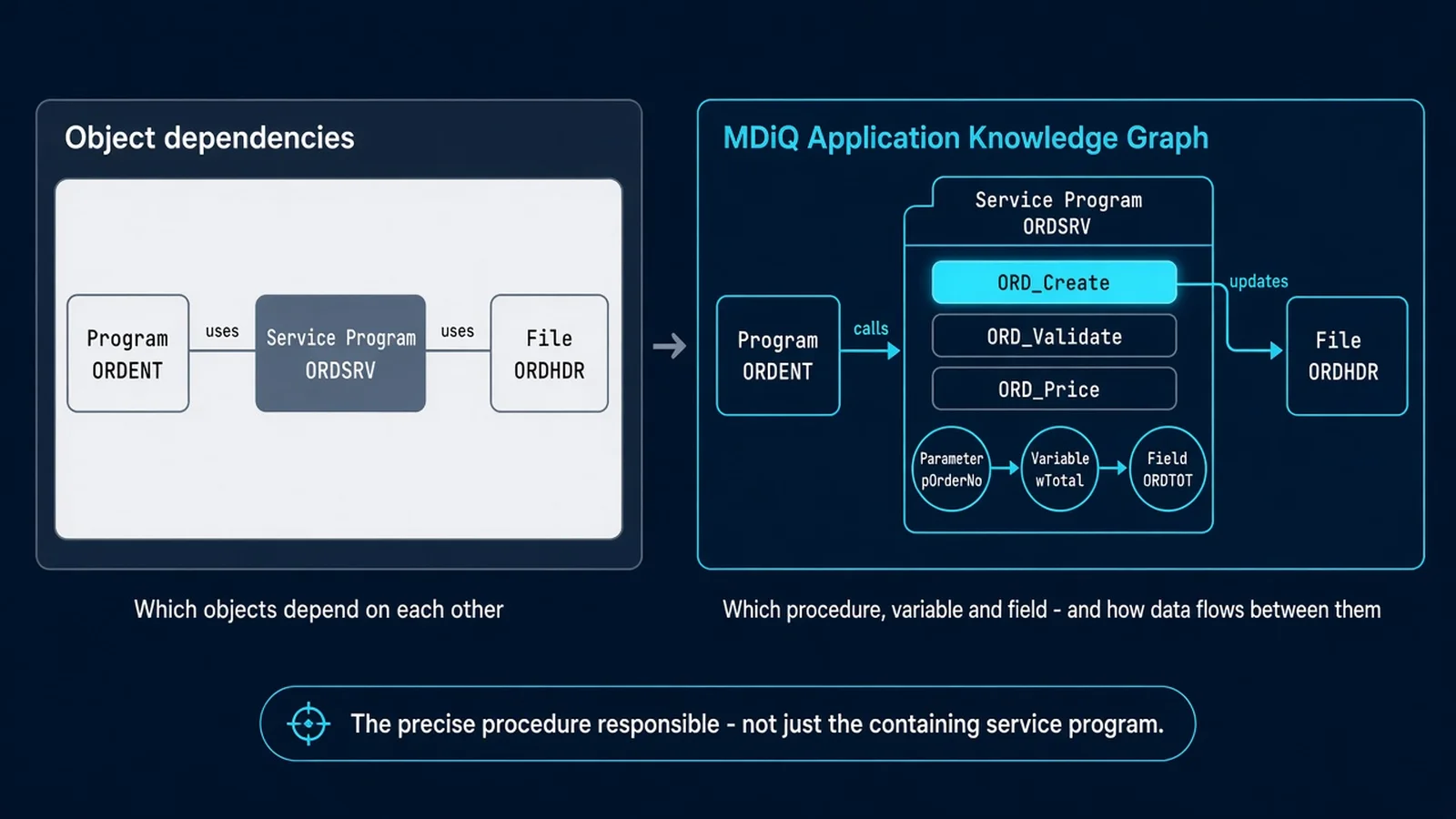
Parsers analyse source code and object metadata to map variable relationships across IBM i applications.
Not just where variables exist
True execution insight
Visibility into the actual logical execution elements inside service programs and modular applications — not only the object that contains them.
Examples of relationships captured
Call structures are captured between programs, procedures and modules in every direction — program-to-program, program-to-procedure, procedure-to-program and procedure-to-procedure.
One Knowledge Graph. Every way you need it.
MDiQ turns your IBM i application into a reusable knowledge service. Developers can explore it visually. AI agents can query it through MCP. Enterprise applications and development tools can consume it through REST APIs or native IBM i SQL Stored Procedures.
MDiQ · Application Intelligence
Application Knowledge Graph
For people
Explore the application through purpose-built views, dashboards, call charts and where-used analysis.
For AI agents
Give MCP-capable AI agents targeted, structured application knowledge instead of raw source.
For tools
Governed access to the Knowledge Graph as structured JSON for custom clients and third-party tools.
For IBM i applications
Query the Knowledge Graph natively on IBM i from SQL, your own programs and existing tooling.
One authoritative source of application knowledge — available wherever you need it.
Analyse • Visualise • Document • Govern — turn application knowledge into insight, documentation and governed change.
Metrics, impact analysis and change scoping.
Get detailed metrics on your application — including object counts, complexity, dependencies and code distribution — to scope impact, estimate effort and identify modernization priorities.
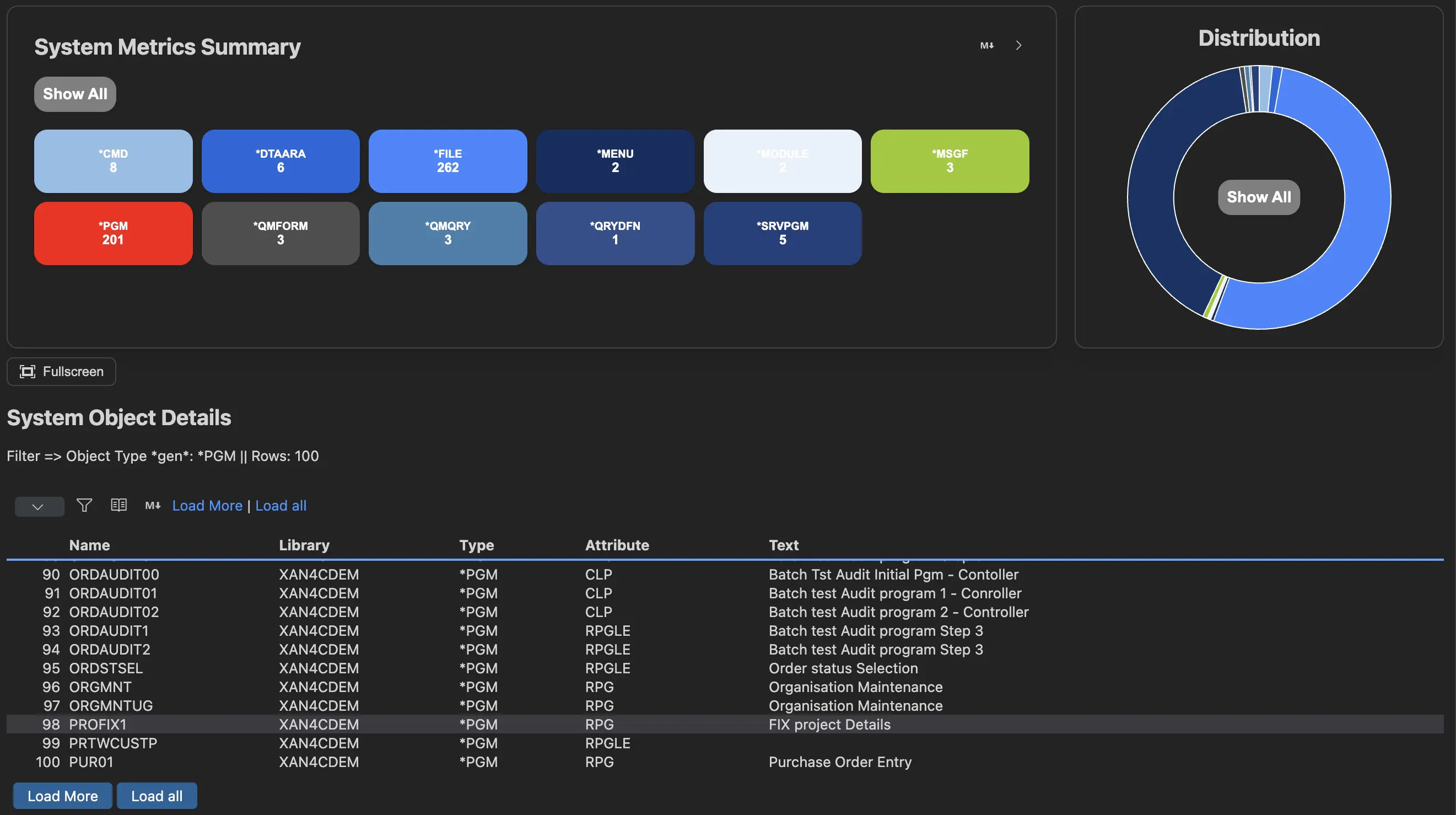
Interactive application maps and object dashboards.
Explore interactive diagrams that show how programs, files, procedures and other objects are connected. Follow call relationships and data usage, trace dependencies and see the bigger picture.
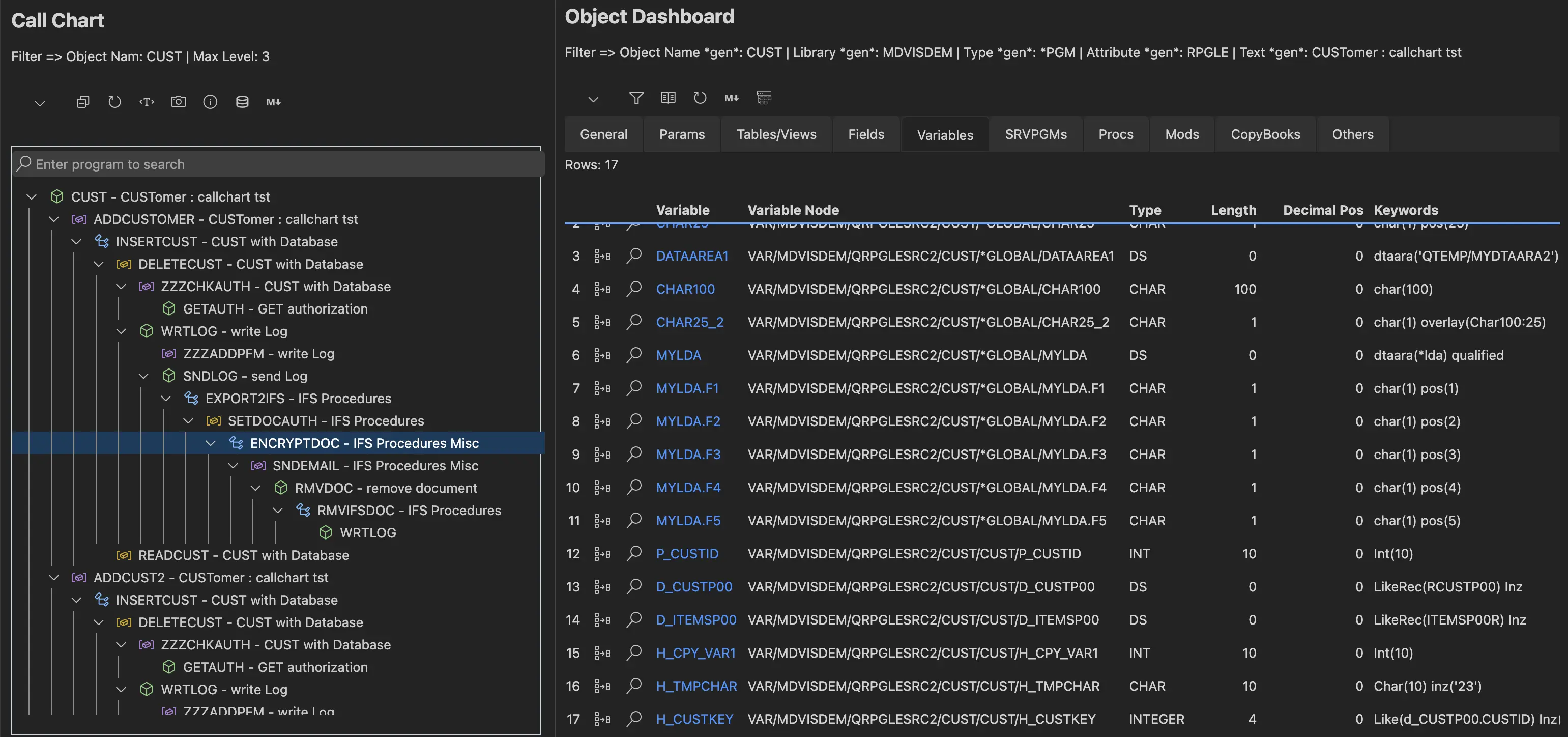
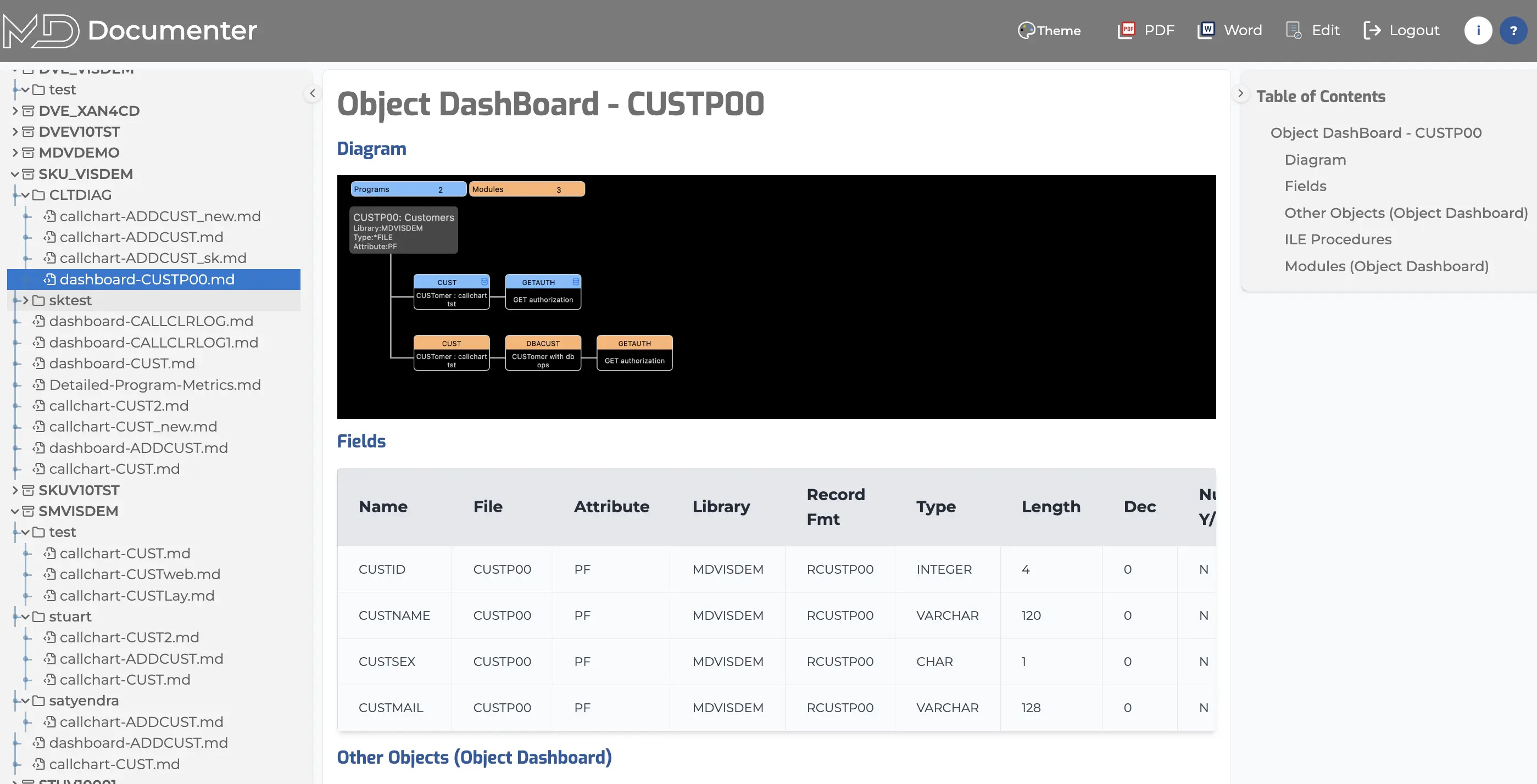
Generate and maintain technical documentation from authoritative application knowledge.
Export structured documentation directly from your Application Knowledge Graph to a web-based, Markdown-based platform and edit it in a modern web interface. Keep your documentation current, searchable and linked to real application objects.
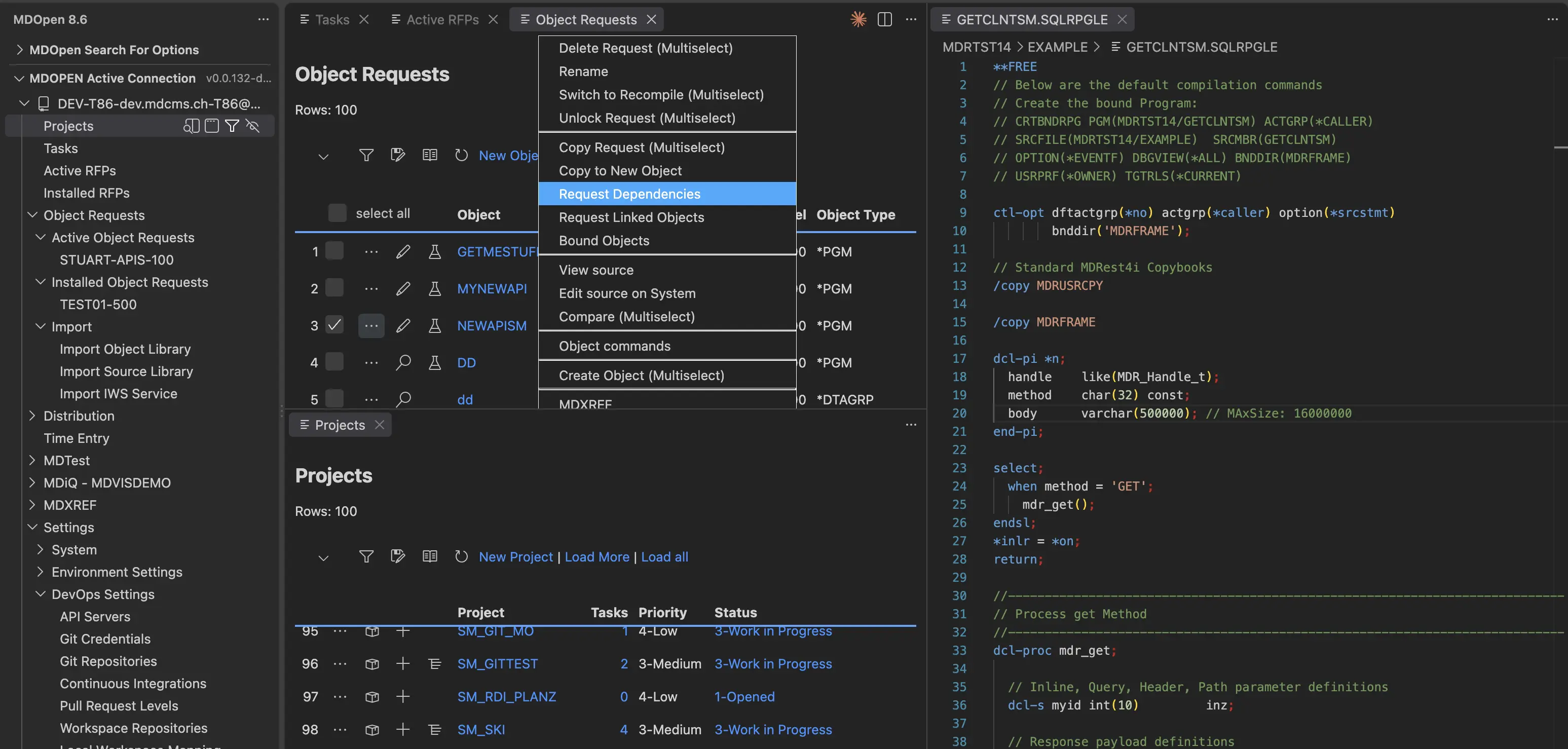
Extend application understanding into controlled software change through MDChange integration.
Go from insight to action. Use the Knowledge Graph to check out related objects, manage changes, compile, implement and deploy — all within proven DevOps governance.
Governed AI
Application understanding is only the first part of safely using AI for enterprise software development. MDiQ supplies authoritative application knowledge, while MDChange keeps AI-assisted change within your established DevOps controls.
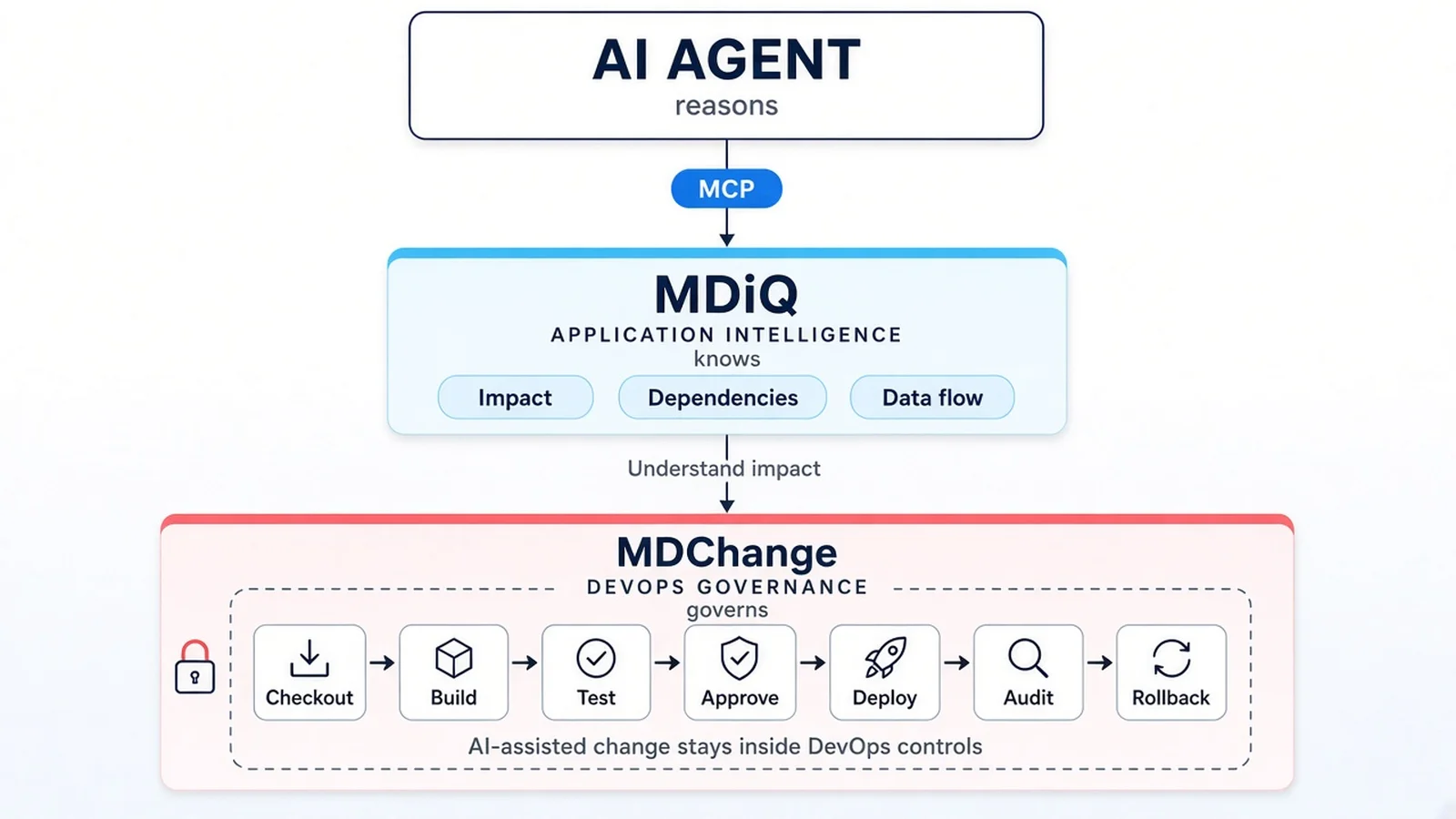
AI reasons.
MDiQ knows.
MDChange governs.
AI agent
Reasons about the task, using the AI tool you choose.
MDiQ — Application Intelligence
Provides the authoritative knowledge needed to understand impact.
MDChange — DevOps Governance
Controls what is permitted to change, and how it reaches production.
Governance and controlled actions are central: an AI agent does not receive unrestricted authority to modify or deploy software — its work participates in the same DevOps controls as any other change.
Complete node-edge mapping with native parsers on the IBM i server — not an off-platform reconstruction of the application.
CI/CD triggers granular repository updates so the Knowledge Graph stays aligned with the live application.
Trace calls and file usage to the exact ILE procedure — not only the service program that contains it.
Intelligent variable mapping, multi-level dependency chains and where-used tracing across even the largest IBM i systems.
Known application relationships instead of AI inference — reducing structural hallucination by giving AI authoritative relationships rather than asking it to infer them repeatedly from source.
Give AI the knowledge it needs — not the entire source tree. Targeted, structured context through MCP, REST and SQL means smaller context, less repeated discovery and lower inference workload.
MDiQ provides the application intelligence layer independently of the AI agent consuming it — designed for IBM Bob and other MCP-capable agents, with REST and SQL always available.
Even when AI runs in your own environment, MDiQ reduces the need to load, search and interpret large source repositories — and controls which relevant knowledge is exposed.
MDDocs associates Markdown documentation with programs, procedures and database elements — and exports to PDF and Word.
For more info, a live demonstration, or to discuss your business and technical needs with the Midrange Dynamics team.
Request Info